


A Case against Chemical Castration
Nikhil Erinjingat
Introduction
The debate over chemical castration as a form of punishment has resurfaced post the Pakistan government’s recent approval of chemical castration for rape convicts. A recent article titled ‘Chemical Castration of Sexual Offenders in India – A Need for Reformation in Indian Anti-rape Laws’ (referred to as ‘article’) published in the NLU Jodhpur’s Criminal Law Blog also argues for chemical castration and raises important points on nature and need for punishment, the role of the criminal justice system in the prevention of crimes, and goal of punishment.
Even though the article of NLU Jodhpur suggests castration as a viable solution for achieving deterrence, reformation, retribution and prevention of crime, an assiduous analysis of the problem points that the solutions of the problems in the criminal justice system are not lack of innovative or stringent punishments. Based on a study of literature on chemical castration, this article argues why chemical castration is not a viable punishment in the long term and has adverse effects on society.
Arguments made in favour of the chemical castration
Several arguments are made in favour of chemical castration which requires to be mentioned before addressing the challenges in implementing it as a form of punishment. The article published by NLU Jodhpur is taken as a reference since it covers varied facets of the topic at hand.
It is argued that chemical castration is the need of the hour to reform the criminal justice system in India. The author of the aforementioned article, however, does not advocate for chemical castration as a “regular punishment” but as an “alternative punishment”. That is, chemical castration must be done only after explaining all the side effects so that the consent of the convict will be voluntary.
The article argues that chemical castration for a specific period can be the treatment for “curing” sexual disorders and to prevent commission of crimes by such persons. The author also provides a workaround Article 21 and claims that if the castration is voluntary, there is no question of violation of the right to life and personal liberty.
The case against chemical castration
The primary reason for an increase in sexual offence against women is not lack of stringent punishment but failure and delay in enforcement of laws, as was observed by Human Rights Watch Survey.
However, even if castration is considered as a potential form of punishment, there are several latent problems in its implementation:
1. Risk of castrated convicts to society: Castrated convicts are a threat to society. The reason why criminals are locked up behind bars is not just for punishing them but also to prevent them from committing any more crimes; that is the basis of the preventive theory of punishment. When criminals are allowed to mingle with society, it poses a potential threat to the people. To aggravate the matter further, when castrated convicts might be frustrated due to their impotence and when frustrated sex-offenders are left amidst public, the possibility of them committing crime, though not rape, is extremely high.
2. Convicts are often known persons:Over 90% of the rape convicts are known to the victim. The effect on the rape victim and her family to see the rapist in the neighbourhood will be grave and gruesome. Even if the convict is not allowed around the victim and her family, the knowledge that the rapist is roaming freely in society will be detrimental.
3. Lack of effective mechanism for surveillance: In India, it becomes difficult to keep a check on convicts out on bail. The Karnataka High Court held that bail is not a license to commit crimes. In such a system, allowing sex offenders who might be frustrated and filled with hate into public will be a risk. Further, chemical castration is a continuous process that requires periodic injection of chemicals. Ensuring that the offenders present themselves at the castration centre is another challenge. There is a significant risk of offenders absconding.
4. Voluntarily giving up fundamental rights: The Supreme Court of India in the Justice KS Puttaswamy (Retd.) & Anr. v. Union of India & Ors. on right to privacy held that fundamental rights cannot be waived off. Therefore, even voluntarily choosing castration cannot be a workaround Article 21 as fundamental rights cannot be waived off.
Effect of increasing punishment
A plethora of literature exists on the effect of increasing punishment on the crime rate. The amendment to IPC post the Nirbhaya rape case provides a good datum line.
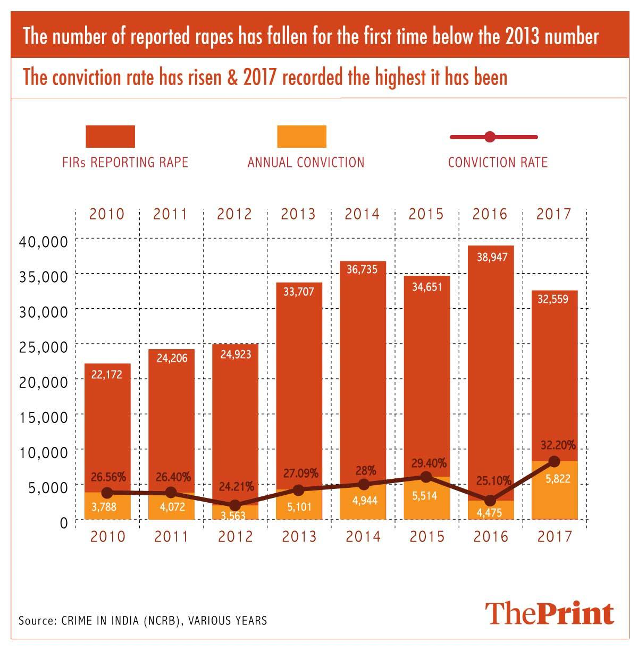
Post Nirbhaya, the punishment for rape was increased by The Criminal Law (Amendment) Act, 2013. However, there exists no evidence to claim that there is a lowering in the rate of rape cases in India. Thus, merely increasing punishment for rape will not be effective when the enforcement of the punishment is delayed significantly.
Why punish?
There is no single objective behind punishing a person. Punishments achieve several goals such as retribution, deterrence, prevention, and reformation. Therefore, isolating a single goal will be an error. Punishing a rape convict with imprisonment for 10 years will achieve deterrence, prevention of any more crime for 10 more years, and retribution as the rape victim will see the rapist being punished. Also, prison authorities have undertaken several programmes for the reformation and rehabilitation of prisoners.Thus, a claim that the Indian criminal justice system is retributive in nature is erroneous.
Conclusion
The success of a criminal justice system is not just in ensuring higher conviction (in absolute numbers) but in maintaining a lower conviction number. The lesser the crimes, the better the system. However, reformation is not the only purpose of a criminal justice system. Retribution is also an important element. It is necessary to ensure that the public and victims feel justice being done. Otherwise, faith in the criminal justice system might wane. The system must find a balance, and castration, due to its adverse effects, is not a viable solution in the long-term to maintain the balance. Thus, even though castration seems to be an effective punishment to reduce crimes and punish criminals at the same time, it will create a domino effect causing significant harm to society.
Castration and similar punishments are myopic solutions that will distract the focus from the problems within the structure of the criminal justice system. Loopholes in the system cause a delay in the administration of justice and sometimes failure to do justice. What the Indian criminal justice system needs today is effective implementation of already existing laws and punishments, transparency in the procedure, faster disposal of cases, and citizen-friendly systems (police stations, courts, etc.).
Finding the right problem is pertinent to finding the right solution, and castration as a solution has flaws not only because it is an impracticable punishment but also because the problem of the criminal justice system is not a lack of strict punishments or failure to achieve retribution.
The author is a fourth year student at Ramaiah College of Law, Bangalore.


Comments